


The State We're In
Shooting stars of summer
By Alison Mitchell, Executive Director, New Jersey Conservation Foundation
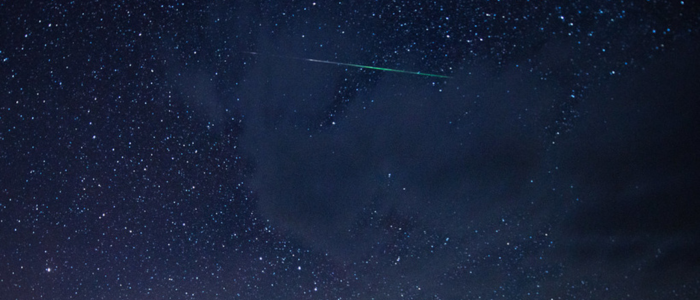
Gazing up at the night sky, a brilliant streak of light – a shooting star! – whizzes past in a brief, magical moment. Some shooting stars contain ancient stardust, tiny diamonds manufactured deep within a collapsing star somewhere in our Milky Way galaxy around 10 billion years ago!
Hydrogen and helium were formed at the very beginning of the universe, during the Big Bang. But almost everything else around us – the elements that make up the Earth, including you and everything you see – were created deep inside stars, where intense heat and pressure fused simpler atoms into more complex ones. When those stars eventually exploded as supernovae, they scattered these elements across space like cosmic seeds.
Over time, gravity gathered this stardust together to form our solar system, including the planets, comets, and asteroids. Nearly everything around us comes from stars that lived and died long before our solar system was born.
Shooting stars are actually meteors, most of which are tiny and disintegrate into dust upon entering our atmosphere. A meteor fragment large enough to reach the ground is a meteorite. You may have heard of some of the more dramatic examples, like the 1969 Allende Meteorite that fell into the Chihuahuan desert in Mexico, or the 2008 Almahata Sitta meteorite that fell into the Nubian Desert in Sudan.
Every summer, we pass right through a dust and meteor cloud strewn through the orbital path of Comet Swift-Tuttle, first recorded by the Chinese in 69 BC. As the dust and tiny fragments fall through our atmosphere, friction with air incinerates the ancient comet fragments, lighting the night sky with shooting stars. When conditions are perfect, especially after 2 a.m., you might see one every minute!
Our passage through this cloud, known as the Perseids meteor shower, started on July 17 this year, and will conclude about Aug. 24, when our planet moves out of the Swift-Tuttle debris field. The greatest concentration of meteors is predicted for Aug. 12 and 13. During peak times, stargazers may see 50-100 shooting stars an hour in dark-sky locations!
Here are some tips for watching the Perseids:
- Grab a blanket or lawn chair and get away from light pollution. If possible, leave the city and suburbs, or find an unlit large open park or ballfield. Beaches, scenic overlooks, and the Pine Barrens can be excellent spots. If you live in a dark sky area and have an open backyard, you can just watch from home.
- Wake up, sleepy head, because the best time to look is between midnight and sunrise. You’ll want to look toward the constellation Perseus (generally to the northeast). You can print out a star map online for New York or Philly or use an astronomy smartphone app to help figure out the best timing. Your eyes need about 20 minutes to adjust to the dark, so turn off flashlights and be patient.
- If you’re lucky, you’ll be treated to a steady shower of meteors streaking across the sky. Most range from the size of a pebble to the size of a grain of sand, and travel at 37 miles per second! You may see some especially bright meteors known as “fireballs.” Rarer is a “bolide,” a type of fireball that explodes in a bright terminal flash at its end.
You may wonder if any of these space rocks fall to Earth. Yes…but not many and probably not near you.
According to the American Meteor Society, 10 to 50 meteorites drop to Earth each day. “It should be remembered, however, that two-thirds of these events will occur over ocean, while another one-quarter or so will occur over very uninhabited land areas, leaving only about 2 to 12 events each day with the potential for discovery by people,” the Society said.
If you miss the Perseids, try to catch the other meteor showers this year. The Orionid shower – associated with the famous Halley’s Comet – will peak on the night of Oct. 21-22; the Taurids on Nov. 9; the Leonids on Nov. 18; the Gemenids on Dec. 13-14; and the Ursids on Dec. 22-23.
To learn more about meteors, visit the American Meteor Society website at www.amsmeteors.org or NASA’s education page at https://spaceplace.nasa.gov/meteor-shower/en/.
And for information about preserving New Jersey’s land – which helps protect dark sky places for stargazing – visit the New Jersey Conservation Foundation website at www.njconservation.org or contact me at info@njconservation.org.
About the Authors
Alison Mitchell
Executive Director
Michele S. Byers
Executive Director, 1999-2021
John S. Watson, Jr.
Co-Executive Director, 2022-2024
Tom Gilbert
Co-Executive Director, 2022-2023
View their full bios here.
Filter
Get The Latest News
From The Garden State
In the
News