


The State We're In
Seeing fall foliage in a new light
By Alison Mitchell, Executive Director, New Jersey Conservation Foundation
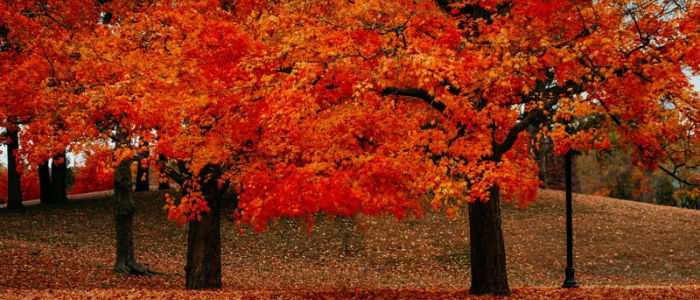
Every fall, New Jersey’s trees put on a spectacular show. A wonderful mix of deciduous trees paints the background of our world into reds, yellows, and bright oranges – maples, oaks, sweetgums, birches, and tulip trees are among the most breathtaking sights in autumn. And it turns out, pretty can also be practical!
To understand why leaves change color, we need to look at chlorophyll, the green pigment that allows plants to capture sunlight and power photosynthesis. Chlorophyll is metabolically “expensive” for a tree to produce, meaning it requires considerable energy and resources to make. As the growing season ends, shorter days with less light combine with cold temperatures to slow photosynthesis. Deciduous trees reclaim their valuable green pigment and its reusable components by withdrawing them back into their twigs.
As the green fades, other pigments become visible like yellow and orange carotenoids that were always present, but invisible to us in spring and summer when they were masked by verdant chlorophyll. Red and purple anthocyanins, in contrast, are newly produced in some leaves during autumn.
But why do the leaves then fall to the ground? Dropping leaves helps trees conserve water through the cold winter. In this state we’re in, frozen winter soils can prevent tree roots from absorbing water. The wide, flat leaves of deciduous trees lose water through tiny pores called stomata. If trees retained their leaves when the ground froze, they would risk dehydration.
Cold temperatures are not the whole story. In tropical deciduous forests many trees shed their leaves during extended dry seasons even though temperatures remain warm. The underlying challenge is the same: water becomes scarce or difficult to obtain, and leaves are an exporter of moisture. Seasonal leaf loss is an adaptation to environmental conditions.
Of course, nature rarely follows simple rules. Young oaks and beeches sometimes retain their dead leaves through winter. One hypothesis is that these leaves may have helped shield the tender buds of the next spring’s growth from winter browsing by giant ground sloths in the distant past, and perhaps from deer today. Retaining leaves carries dehydration risks but bud protection may have offered a worthwhile trade-off. But this theory has never been tested.
Back to the beauty. The earliest autumn colors that brighten our landscapes may serve an additional purpose! The late Ted Stiles, biologist and Rutgers professor (who trained many students essential to our state’s scientific and conservation community), proposed an intriguing hypothesis centered on what he called “fruit-flagging.” Among the roughly 20 deciduous plant species in his New Jersey forest observations that change color especially early – while most surrounding vegetation remains green – nearly all have fruits that ripen at the same time and are dispersed by birds. Could these plants be advertising their ripe fruits through eye-catching colors?
By withdrawing chlorophyll early, a plant sacrifices some late season photosynthesis. But its newly conspicuous foliage may help fruit-eating migratory birds locate an important food source. The birds consume the fruits and later deposit the seeds, helping the plants spread beyond the shade of the parent. In this interpretation, autumn color may also be an integral part of a plant’s reproductive strategy. We don’t know for sure, but it’s an interesting example of how our understanding of the natural world is still evolving.
One thing is clear. As we pick pumpkins or enjoy a warm cup of tea surrounded by stunning fall foliage, the trees are busy recovering valuable resources, protecting themselves against winter dehydration, and participating in ecological relationships that connect plants, birds, and the wider landscape.
Those brilliant reds and golds are clues to the remarkable strategies that help our forests survive, renew themselves, and thrive year after year.
To learn more about preserving New Jersey’s land and natural resources, visit the New Jersey Conservation Foundation at www.njconservation.org or contact info@njconservation.org.
About the Authors
Alison Mitchell
Executive Director
Michele S. Byers
Executive Director, 1999-2021
John S. Watson, Jr.
Co-Executive Director, 2022-2024
Tom Gilbert
Co-Executive Director, 2022-2023
View their full bios here.
Filter
Get The Latest News
From The Garden State
In the
News