


The State We're In
The hidden holiday magic of native evergreens
By Alison Mitchell, Executive Director, New Jersey Conservation Foundation
The Christmas tree is an age-old tradition going back to the Pagans, and for many generations people around the world have been decorating their homes with winter greenery to celebrate the holiday season. For many families, Christmas trees and wreaths foster a sense of continuity and a green reminder that warmth and color will return after winter’s dimmest weeks. Most Christmas trees are firs and spruces, but New Jersey has several other beautiful and important native evergreens to toast this season.
This cast of trees evolved over thousands of years in tandem with New Jersey’s soils, storms, and wildlife. Balsam fir and red spruce, which are listed as endangered, are native to our northern mountains and if you’re lucky, you can also find them grown horticulturally as Christmas trees! Have yourself a natural little Christmas…
New Jersey’s native evergreens embody endurance and winter beauty. The pitch pine is perhaps the most emblematic. Home and habitat to bald eagles, timber rattlesnakes, and many unique frog and salamander species, these sturdy trees thrive in the sandy, acidic soils of the Pine Barrens. The thick bark and heat-activated cones are built for wildfires, allowing for survival and regeneration in a fire prone landscape. Even in the dormant season, when much of the forest turns brown, the pitch pine continues photosynthesizing, keeping the landscape alive with color and activity.
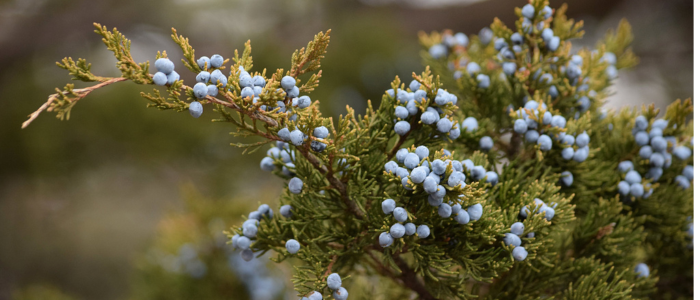
Another New Jersey native, the Eastern red cedar – actually a juniper – plays an equally vital role. Its small, berry-like cones ripen into a dusty blue, and are an important food source for birds and other wildlife during the colder months. The cones have an astringent wax coating that deters mammals but leaves plenty of food for birds, who digest wax as if it was sugar and later disperse the tiny seeds. The tree’s dense, architectural branching also provides shelter during snowstorms, making it a haven for wildlife.
Turning south to the state’s coastal plain, the majestic Atlantic white cedar once formed sweeping swamp forests. These trees prefer saturated, low-oxygen soils that few other evergreens can tolerate, creating a habitat found almost nowhere else. Their straight, pale trunks rise above slow-moving water where salamanders breed, bald eagles hunt, and rare plants anchor themselves in the muck. Though the acreage of these cedar swamps has been greatly reduced by centuries of logging and development, the stands that remain represent one of New Jersey’s most ecologically rich winter landscapes.
Another quintessential holiday plant that typically grows along the coastal plain is the American holly, often displayed on mantels and dinner tables because of its bright red berries and deep green leaves. Holly berries feed tens of thousands of American robins that thrive here in winter. These botanical beauties can even survive in the moist soils of central and southern New Jersey, which is one reason that Millville, in Cumberland County, is referred to as the “Holly City”!
Even sometimes overlooked species, such as Virginia pine or shortleaf pine, offer valuable contributions. Their seeds feed birds like finches and nuthatches, their branches host overwintering insects, and their needles layer the forest floor and support specialized plant communities.
When deciduous forests stand bare, it is the pines, cedars, and junipers that maintain photosynthesis, shelter, and stability, keeping the natural world running as temperatures plunge.
So while the Fraser and Douglas firs glowing in windows are lovely and welcome, the evergreens standing outside in the cold are doing the slow, sustaining work that keeps the state’s wildlife and landscapes alive. True symbols of nature’s winter endurance, our native evergreens continue to shine long after the ornaments and lights are packed away.
To learn more about how you can help preserve New Jersey’s natural resources, visit the New Jersey Conservation Foundation at www.njconservation.org or reach out to us at info@njconservation.org.
About the Authors
Alison Mitchell
Executive Director
Michele S. Byers
Executive Director, 1999-2021
John S. Watson, Jr.
Co-Executive Director, 2022-2024
Tom Gilbert
Co-Executive Director, 2022-2023
View their full bios here.
Filter
Get The Latest News
From The Garden State
In the
News