


The State We're In
Sounds of a New Jersey summer
By Alison Mitchell, Executive Director, New Jersey Conservation Foundation
Let’s face it – amid all the bustle of human activity, New Jersey has a fabulous summer soundtrack!
Those of us who look back on childhoods in the Garden State might recall long days at the beach and the taste of hot dogs and ice pops. But there’s nothing like the familiar sounds of summer – the late-afternoon coo of the mourning dove or the buzz of cicadas in the heat.
Things usually liven up as the sun goes down.
A shout out to crickets for starting off the evening with their iconic summer chirps! The Eastern whip-poor-will – aptly named for their “WHIP poor WILL” calls – is another classic on warm East coast nights. Rarely seen, but often heard, these nocturnal birds are listed by the State as Species of Special Concern due to forest fragmentation, pesticides, and loss of habitat.
Rest assured that if you’ve spent a summer night in New Jersey, you’ve heard the katydids. These leaf-green insects, related to grasshoppers and crickets, are typically found high in trees and shrubs where they use specialized structures on their wings to produce sound. Their calls are loud and sound argumentative, often described as “katy-did, katy-didn’t, katy-did, katy-didn’t.”
The nighttime choruses of deep, throaty croaks and musical trills of frogs join the symphony, calling from ponds, marshes, and even roadside ditches. The American bull frog is the state’s largest, with a deep, resonant, and low-pitched “jug-o-rum” or “br-w-w-w-m” sound filling the air.
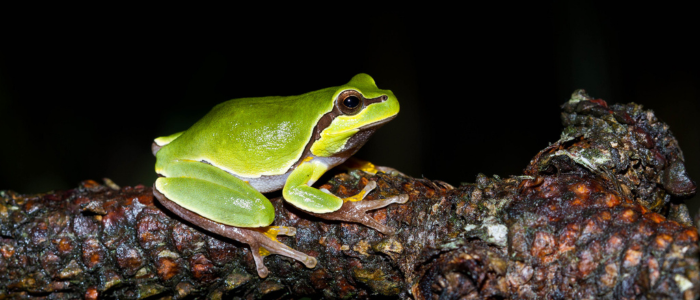
The mating calls of Northern gray tree frogs can be heard all over New Jersey through August. They advertise with a melodious trill lasting about half a second and repeated every few seconds. Their squeaky chirps and weeps are quite distinct but perhaps not as recognizable as the “quonk” and “honk” of the Pine Barrens treefrog. The vibrant green treefrogs call from the ground, shrubs, or other vegetation in specialized acidic habitats like Atlantic white cedar swamps and pitch pine lowlands carpeted with Sphagnum moss.
A magical explosion of sorts occurs when the Magicicadas take over. These large, plant-feeding insects spend most of their lives underground as nymphs, feeding on tree roots for 17 years before emerging as adults! There are 12 broods of these periodical cicadas, and two that occur in New Jersey consisting of three species.
But where will they emerge and when? Whereas Brood II (on a 1996, 2013, and 2030 schedule) occurs pretty much throughout New Jersey, Brood X (appearing in 2021 and 2038) is mostly confined to the western counties from Hunterdon south to Salem. When they surface, their calls can fill the air from morning into evening with high-pitched buzzing. The sound is produced by males using specialized structures called tymbals to attract mates. It’s a big sound for a very small critter!
And every so often, you might hear something that cuts through it all. A red fox calling out in the distance. Common across New Jersey, they are mostly active at night or around dawn and dusk. Their vocalizations are surprisingly varied, including barks, screams, and high-pitched calls used to communicate over long distances. One of the most distinctive is the vixen’s call – a sharp, almost eerie scream made by females during the winter breeding season. But foxes vocalize year-round and their sounds often carry through summer evenings, reminding us that larger wildlife is moving through the landscapes we share.
Whether you’re at the Shore, in the suburbs, near the woods, or close to an urban park, the mix of this natural melody might change a little, but the feeling it evokes is undeniable.
The creatures emitting these splendid sounds depend on unique habitats like the Pine Barrens, thriving forests, unpolluted wetlands, open space, and clean air. When those places shrink or change, the chorus changes too. It dampens. We usually think of nature as peaceful, but a quieter natural world signals tremendous loss.
That’s why protecting the places that support this music is so important. It safeguards a uniquely New Jersey experience shared by all living things. So this summer, take a few moments to listen. And consider what it takes to keep the soundtrack playing for generations to come.
To learn more about preserving New Jersey’s land and natural resources, visit the New Jersey Conservation Foundation at www.njconservation.org or contact info@njconservation.org.
About the Authors
Alison Mitchell
Executive Director
Michele S. Byers
Executive Director, 1999-2021
John S. Watson, Jr.
Co-Executive Director, 2022-2024
Tom Gilbert
Co-Executive Director, 2022-2023
View their full bios here.
Filter
Get The Latest News
From The Garden State
In the
News