

The State We're In
The evolving story of New Jersey’s chestnuts
By Alison Mitchell, Executive Director, New Jersey Conservation Foundation
For thousands of years, an estimated four billion native American chestnut trees provided bounty for Indigenous Peoples, wildlife, and entire forest ecosystems in New Jersey.
Each fall, nuts and leaves from the trees would blanket forest floors with nutrients. Rich in calories, vitamin C, and antioxidants, chestnuts were an integral part of the food chain. Insects feeding on leaves were eaten by fish or birds, and other larger animals fed directly on the chestnuts, including squirrels, deer, bear, and turkeys.
But in the late 1800s, a bark fungus was accidentally introduced into North America on imported Asiatic chestnut trees. The native trees had little resistance, and the resulting blight – first discovered in 1904 in New York City – quickly spread.
It was an ecological tragedy of epic proportions. Within 60 years, billions of American chestnut trees had died or were preemptively cut down to harvest the valuable timber before the blight took hold. Although a small percentage of trees survived, the great chestnut forests that had existed for millennia were gone.
Today, if you plant an American chestnut tree in New Jersey, it will eventually be infected with blight. The fungus has settled in, persisting in other tree species, the air and soil, and on dead wood.
While it doesn’t kill the root system right away, it seeps into American chestnut trees through seams in the expanding bark and prevents nutrients from traveling up the stem. Trees’ immune systems don’t respond to this disease; their resistance is predetermined at birth. Without the ability to protect themselves or move, their fate is pretty much sealed.
Yet, all hope for the mighty chestnut is not lost! The American Chestnut Foundation is on a mission to return these treasures to landscapes all around the United States and is actively planting saplings with help from local volunteers, nonprofit partners, and scientists. Lake Graboski, the Foundation’s North Central Regional Science Coordinator, says they are using every tool available, including creating and examining hybrid versions of the American chestnut to foster blight resistance.
New Jersey Nut Farms is also using the hybridization technique, and with some success! They planted their first blight-resistant Chinese-American hybrids in 2019, and ninety percent have grown into strong trees.
Each year, the couple that runs the farm has added hundreds of trees to their orchards in Medford and Chesterfield in Burlington County. Between the two locations, more than 2,000 chestnut trees are now thriving!
They’ve got big plans, according to their website which states: “Our dream is to grow a diverse perennial farm and reintroduce chestnuts to our region’s cuisine.” They use non-toxic, sustainable farming practices to ensure that crops are free from harmful chemicals.
Present day efforts to revive the American chestnut population harken back to the time when many Indigenous Peoples managed landscapes to improve habitat for the trees, including New Jersey’s own Lenape tribe.
These acts of restoration also help to repair the overall ecosystem. “I don’t think we’re going to be restoring the forests of the past because so much has changed,” says Graboski. “But we can try to improve overall forest resiliency. Resiliency would mean our forests are good homes for animals and humans again. Our forests today are unable to provide that function.”
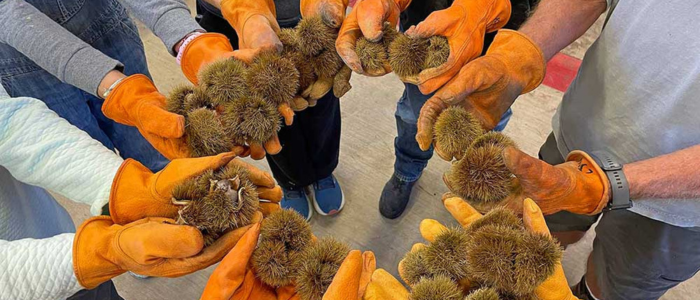
Tis the season to enjoy these traditional nuts, since they ripen and fall from late September to early November. Railroad cars overflowing with native chestnuts to be sold as a holiday treat are a thing of the past, so unless you’ve managed to find a local seller, the chestnuts roasting on an open fire today are from overseas. But with a little luck, and a lot of persistence by restoration groups, New Jerseyans may once again enjoy a taste of American chestnuts!
To learn more about American chestnut trees and volunteer or donate to the American Chestnut Foundation, please visit www.tacf.org/. To learn more about New Jersey Nut Farms, visit https://newjerseynuts.com/.
For more information about preserving New Jersey’s land and natural resources, visit the New Jersey Conservation Foundation website at www.njconservation.org or contact me at info@njconservation.org.
About the Authors
Alison Mitchell
Executive Director
Michele S. Byers
Executive Director, 1999-2021
John S. Watson, Jr.
Co-Executive Director, 2022-2024
Tom Gilbert
Co-Executive Director, 2022-2023
View their full bios here.
Filter
Get The Latest News
From The Garden State
In the
News