


The State We're In
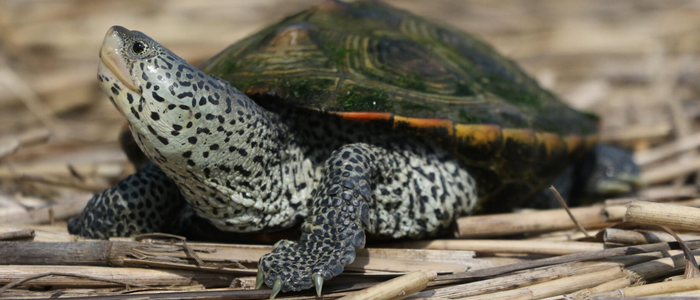
Diamondback terrapins: Another New Jersey jewel
By Alison Mitchell, Executive Director, New Jersey Conservation Foundation
Northern diamondback terrapins are the only turtles in the world that spend their entire lives in brackish coastal environments, where freshwater and saltwater meet. Naturally, they love our state!
Like many wild residents of this state we’re in, terrapins have a long and complicated history with people. In the 1800s and early 1900s, they were heavily harvested for food and nearly hunted to extinction. Today, terrapins are protected as a nongame species and cannot legally be collected. New Jersey now recognizes the Northern diamondback terrapin as a Species of Special Concern, reflecting their need for continued conservation attention. Yet even without hunting, they remain vulnerable.
One of their biggest challenges is that the places they need to live and reproduce overlap with places where people live, work, and travel. Coastal development has eliminated and altered portions of their salt-marsh habitat, while roads and bulkheads cross through marshes and separate feeding and nesting areas.
Add pollution, entanglements in fishing and crabbing gear, illegal collection, climate change, and shifting coastal conditions, and it’s easy to see why terrapins are declining in the Garden State.
The annual nesting migration is a particularly critical time in terms of road mortality for these Jersey gems. Beginning in late spring and continuing into summer, adult female terrapins leave the relative safety of the marsh to search for sandy or gravelly upland areas where they can lay their eggs. Unfortunately, road shoulders can look remarkably similar to natural nesting habitat. As a result, females sometimes try to cross busy coastal routes, and they’re no match for motor vehicles.
There are several simple things motorists, boaters, and recreational crabbers can do to help make conditions safer for terrapins and many of their brethren.
- Watch out for turtles on coastal roads. If you see a terrapin in the road – and it is safe to do so – carefully carry it to the side of the road in the direction it was already traveling. Never catch a turtle by the tail! (For snapping turtles, avoid handling them directly; a car mat or other object can sometimes be used to encourage or help move them to safety).
- Give nesting females plenty of space. If you see a terrapin nesting, observe from a distance and don’t disturb her.
- Use bycatch-reduction devices when crabbing. Terrapins can enter underwater crab traps and drown when they can’t reach the surface. This unintentional trapping is known as “bycatch”. Properly installed bycatch reduction devices can help prevent terrapins from entering traps in the first place.
- Never collect terrapin! They are protected wildlife in New Jersey. Because their habits evolved over many generations, moving them long distances can be devastating. They want to lay their eggs where they were hatched. If you move them too far, they become disoriented and can’t find that spot
- Report what you see. Photos and observations of terrapins, including road sightings and road mortality, can help researchers and conservationists understand where turtles are moving and where protective measures may be needed. New Jersey’s Wildlife Tracker provides a good way to report observations of species of conservation concern: https://dep.nj.gov/njfw/wildlife-tracker-app/.
Residents looking to help can give some of their time to the Terrapin Nesting Project, a community-run conservation effort on Long Beach Island that relies entirely on volunteers. Visit https://www.terrapinnestingproject.org/how-you-can-help-1
The State also needs to better protect salt marshes, including elevating them to stem the loss from sea level rise. One promising strategy is the spreading of material pulled out of waterways from dredging projects onto the sinking marshes. That is happening in some areas but it needs to be accelerated.
We’re also losing ground to phragmites – an invasive plant that takes over wetlands and has very limited habitat value. We should invest in biological controls for “phrag,” and restore the tidal flow we’ve damaged with development. The roads we’ve built across the marshes have culverts for the water to pass through but the system typically doesn’t work the way it should because the pipes are too small. Without proper flow, the salinity of the water changes to benefit the growth of phragmites. Let’s redesign and replace the culverts, for goodness sake!
New Jersey’s diamondback terrapins have survived centuries of change. With more awareness and targeted action, we can help ensure they remain part of our coastal landscape well into the future.
To learn about preserving New Jersey’s land and natural resources, visit the New Jersey Conservation Foundation website at www.njconservation.org or contact me at info@njconservation.org.
About the Authors
Alison Mitchell
Executive Director
Michele S. Byers
Executive Director, 1999-2021
John S. Watson, Jr.
Co-Executive Director, 2022-2024
Tom Gilbert
Co-Executive Director, 2022-2023
View their full bios here.
Filter
Get The Latest News
From The Garden State
In the
News