


The State We're In
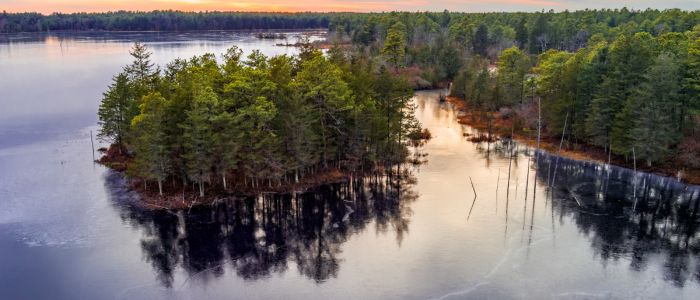
The frozen history of the New Jersey Pine Barrens
By Alison Mitchell, Executive Director, New Jersey Conservation Foundation
When people think of the New Jersey Pine Barrens, they usually focus on the fascinating life there: rare orchids, carnivorous plants, pine snakes, frogs that “quonk” from hidden pools. The region’s biodiversity is rightly celebrated. But there is another kind of diversity hiding underneath. Older, quieter, and far less appreciated, the area’s geodiversity – the range of landforms, soils, and physical processes that shape the landscape itself – actually makes the Pine Barrens what it is.
This place is part of the United Nations-designated Biosphere Reserve because of its unusual habitat. Yet, without understanding the ice, the cold, and the strange polar conditions that once ruled this place, we miss the deeper story of how the Pine Barrens came to be.
Today, it’s hard to imagine southern New Jersey as anything but temperate forests and wetlands. Yet for much of the last 2.5 million years, the region sat in the shadow of a continental ice sheet. At its peak, that sheet was over a mile thick and roughly 30 percent larger than Antarctica’s ice sheet today.
Twenty-six thousand years ago, that immense mass of frozen water was parked just to the north. Air sitting atop the ice grew colder and denser, then spilled southward like an invisible avalanche. As a result, the Pine Barrens became cold, dry, and windy, and the forests and grasslands that inhabited the coastal sands slowly gave way to a polar desert. The ground froze so deeply that it cracked.
Mark Demitroff, natural historian and professor at Stockton University, began working in the Pine Barrens as a tree expert years ago and started to question what he was seeing in the land itself. Prevailing models said the region never got cold enough to produce permafrost. But the ground told a different story. Demitroff began searching for features called ice wedges, which are cracks that form when intensely cold ground shrinks and splits open, later filling with water that freezes and widens the fracture.
What Demitroff and his colleagues discovered in the Pine Barrens overturned old assumptions. The ground here did freeze – repeatedly. In fact, the freeze extended all the way to Virginia. Ice age after ice age left its imprint in the soil. “When it comes to permafrost,” Demitroff says, “everything changes. It’s a world so different from anything you can imagine, and some weird things happen.”
Those “weird things” are still with us. Wetlands like spungs, blue holes, cripples, and vernal pools form a subtle but intricate pattern across the Pine Barrens.
Many of these cold-climate, nonglacial (or periglacial) landforms create rare habitats. Roughly half of New Jersey’s endangered species depend on wetlands shaped by this ice-age legacy. Cultural history is layered into these niches too; people have exploited, avoided, named, and mythologized them for millennia.
Yet geodiversity is rarely discussed, much less protected. Development pressures, illegal off-road vehicle damage, and simple neglect threaten these extraordinary landforms that can never be replaced once erased. While we work to protect species, we often ignore the physical foundations that make their ecosystems possible.
To truly understand and conserve the very special part of our state, we must broaden our idea of nature to include not just what grows and moves, but also the ancient landforms that underpin it all and that endure to this day.
It is fascinating that the remarkable biodiversity of the Pine Barrens exists only because of its frozen history measured in deep time – a landscape written by ice, wind, and cold.
To learn more about the history and geodiversity of the Pine Barrens, check out Demitroff’s book, Soggy Ground: https://www.barnesandnoble.com/w/soggy-ground-mark-demitroff/1144846841.
For more information about preserving New Jersey’s land and natural resources, visit the New Jersey Conservation Foundation website at www.njconservation.org or contact me at info@njconservation.org.
About the Authors
Alison Mitchell
Executive Director
Michele S. Byers
Executive Director, 1999-2021
John S. Watson, Jr.
Co-Executive Director, 2022-2024
Tom Gilbert
Co-Executive Director, 2022-2023
View their full bios here.
Filter
Get The Latest News
From The Garden State
In the
News