


The State We're In
The fall of dams and rise of rivers
By Alison Mitchell, Executive Director, New Jersey Conservation Foundation
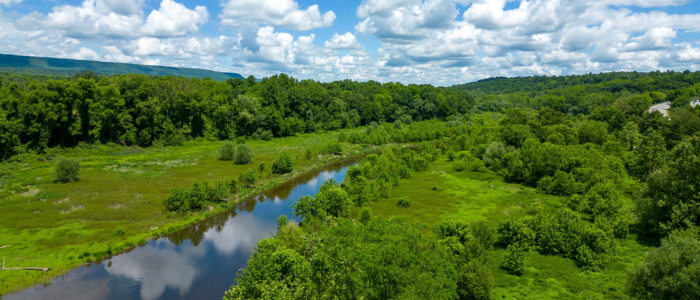
Photo (c) Bill Amos / The Nature Conservancy
For nearly 15,000 years, American shad and other migratory fish moved freely up the Paulins Kill River from the Delaware to spawn. That journey through Sussex and Warren counties was cut short about 115 years ago with the installation of several dams on the river to power the region’s growing industry, one of which blocked the river’s mouth. Damming the river interrupted its life cycle, changing core aspects of the waterway that had benefited wildlife and people.
Most of our state’s aging dams – built in the 1800s and early 1900s to power mills that no longer exist – continue to block fish, trap sediment, worsen flooding, and pose growing safety risks. Of New Jersey’s roughly 1,700 regulated dams, fewer than a dozen still serve an essential function. The rest remain largely out of nostalgia, misunderstanding, or a lack of focused attention on removing them.
Not all rivers in New Jersey share this history. The Delaware, for example, remains the longest undammed river east of the Mississippi! Its free-flowing character is not an accident, but the result of decades of public opposition to a massive federal proposal for the Tocks Island Dam in the 1960s. After a long battle, the project was shelved in 1975, and land already acquired by the federal government was transferred to the National Park Service. That decision gave rise to the Delaware Water Gap National Recreation Area – a 70,000-acre park protecting 40 miles of free-flowing river. Today, the Delaware supports thriving ecosystems, outdoor recreation, and drinking water for millions.
Perhaps taking inspiration from the free-flowing Delaware, some New Jersey communities have begun to look at returning the natural flow to their rivers. The Paulins Kill became an early focus for the restoration movement. Now, after nearly a decade of work, four dams have been removed – reopening 45 miles of river and tributaries and letting the river flow once again.
The change was almost immediate!
“We’re already seeing American shad above the dams that were removed,” says Beth Styler Barry, Director of Freshwater Program for the Nature Conservancy in New Jersey. “We’re seeing sea lamprey and American eel. It used to be that only the biggest eels could make it upstream. Now we’re seeing all age classes.”
When a dam slows water, sediment piles up, water warms, and rocky streambeds turn muddy. Once the barrier is gone, rivers regain their natural flow, temperature, and structure. “All of the organisms in a river like the Paulins Kill evolved to live in a cool, flowing, rocky-bottom stream,” Styler Barry explains. “When you restore flow, the river begins to heal itself.”
That healing matters for people, too.
Geoffrey Goll, engineer and president of Princeton Hydro, worked with the Nature Conservancy to remove the Paulins Kill dams. He explains that removing obsolete dams reduces flood risk, improves public safety, and eliminates long-term financial burdens for towns and private owners. “If you don’t take care of them, they’ll come out on their own and that’s a much bigger problem,” he says.
Climate change is making those risks worse. With more intense rainfall events, aging dams not built to withstand the pressure are bound to fail.
Dams have also been pulled from the Musconetcong and Raritan rivers, with a total of about 10 removals statewide. However, those efforts can sometimes be met with resistance. Residents worry about losing waterfalls or ponds they’ve grown attached to, or they have trouble envisioning what an unleashed river will look like.
“People think you’re going to take the dam out and leave a mud pit,” says Styler Barry. “But when they see – after a year, when vegetation is established and the river is flowing again – they change their minds.”
Goll has seen the same shift. “Once dams are gone, people turn around and think, ‘It’s actually pretty nice,’” he says. “They start to see the value of a free-flowing river.”
Removing antiquated dams comes down to restoring function for people and wildlife. Letting more rivers flow freely again may be one of the smartest, simplest climate adaptation and conservation choices New Jersey can make.
To learn more about the Nature Conservancy, please visit https://www.nature.org/en-us/. To learn more about Princeton Hydro, visit https://princetonhydro.com/. Join an upcoming webinar by ANJEC on January 28th to learn more about dam removals! Register here: https://secure.givelively.org/event/association-of-new-jersey-environmental-commissions/dam-removal-in-nj
For more information about preserving New Jersey’s land and natural resources, visit the New Jersey Conservation Foundation website at www.njconservation.org or contact me at info@njconservation.org.
About the Authors
Alison Mitchell
Executive Director
Michele S. Byers
Executive Director, 1999-2021
John S. Watson, Jr.
Co-Executive Director, 2022-2024
Tom Gilbert
Co-Executive Director, 2022-2023
View their full bios here.
Filter
Get The Latest News
From The Garden State
In the
News