


The State We're In
Mighty moths, our unsung pollinators
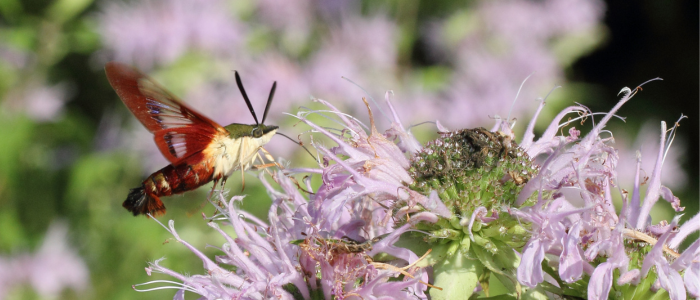
By Alison Mitchell, Executive Director, New Jersey Conservation Foundation
Ask someone to name a pollinator, and they’ll likely respond with a bee or butterfly, or perhaps a hummingbird. But moths? They rarely make the list.
“Moths have been underappreciated,” says Jill Dodds, a biologist who has spent decades surveying rare and endangered species across New Jersey. “I just started looking at them, and it was addictive.” That curiosity has taken her across this state we’re in, where she’s photographed more than 1,000 of New Jersey’s estimated 2,500 moth species.
Most moths are nocturnal, which means they work while we sleep. For a long time, scientists focused on pollinators that work in the sun. Most studies, after all, happen during the day. But that leaves out a fascinating world of activity after dark.
“Nocturnal pollinators play a much larger role in crop pollination than was earlier understood,” explains Dodds. For every butterfly, there are likely many more moths doing the business of pollination.
Some moths pollinate by accident, brushing against pollen as they sip nectar and carrying it from flower to flower. Tiny “micro moths” – with wingspans less than an inch – feed directly on pollen and are often covered in it. That pollen is basically hitching a ride to the next plant.
And then there are the specialists. This is where things get really interesting.
Certain orchids rely on very specific moths to reproduce. Their flowers have long tubes filled with nectar that are accessible only to moths with just the right tongue length. When the moth reaches in, it picks up bundles of pollen that stick to its face. At the next flower, the pollen is delivered exactly where it needs to go. “These plants are dependent on those specific moths,” Dodds says. If they decline, the plants struggle.
Moths are also a crucial part of the food web and an essential source of energy for birds. One pair of songbirds may feed their young 10,000 caterpillars. As go the moths, so go our feathered friends.
And like many insects, moths are in decline, much of it due to our modern agricultural practices which are heavy on chemicals. In decimating caterpillars and their host plants, we are driving a collapse of the larger food web.
A 2019 study found that a whopping 40 percent of insect species are threatened with extinction, citing habitat loss due to agricultural activities – including pesticides – as a factor, along with climate change. Artificial lighting adds to the challenge for moths as it disorients them and pulls them away from behaviors that they rely on to survive.
Most people think of moths as pests making holes in their favorite sweaters or chewing through pantry goods. But Dodds notes that these moths only account for a tiny subset of species, often nonnative critters.
In fact, some adult moths don’t eat at all and are only searching for mates. Others feed on nectar, pollen, leaf litter, or even fungi. Like any large group of animals, they vary quite a bit. Though many are subtle, some are quite colorful. Behold the orange and brown mint moth!
We need to develop a greater appreciation for these altruistic pollinators – toiling in the background, pollinating plants, feeding birds, and holding our ecosystems together.
Dodds suggests a simple way to witness these humble beauties: go outside at night. You might find moths fluttering at a streetlight or porchlight. Look closely for caterpillars tucked beneath leaves. Some even glow under a blacklight!
You can see and learn more about these mysterious creatures by attending a “moth night” hosted by experts, perhaps during National Moth Week (it’s a thing!) which is in late July every year. Learn more and visit the event map at https://nationalmothweek.org/.
To learn more about preserving New Jersey’s land and natural resources, visit the New Jersey Conservation Foundation at www.njconservation.org or contact me at info@njconservation.org.
About the Authors
Alison Mitchell
Executive Director
Michele S. Byers
Executive Director, 1999-2021
John S. Watson, Jr.
Co-Executive Director, 2022-2024
Tom Gilbert
Co-Executive Director, 2022-2023
View their full bios here.
Filter
Get The Latest News
From The Garden State
In the
News