

The State We're In
The Pine Barrens is good at keeping secrets
By Alison Mitchell, Executive Director, New Jersey Conservation Foundation
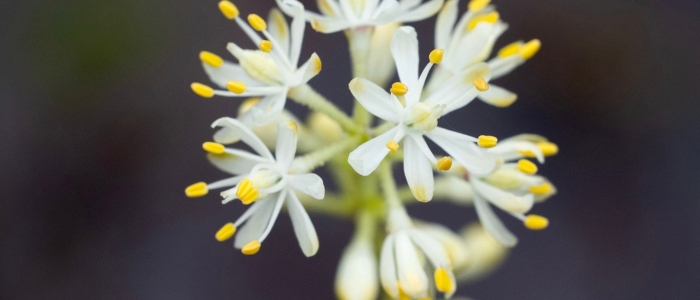
Photo: Pine Barrens’ Triantha novacaesarensis (c) David Taylor
In a place as well-traveled and studied as New Jersey, it’s easy to assume that there aren’t many natural surprises left. And yet, deep in the Pine Barrens, a quiet botanical mystery has been unfolding for thousands of years.
Tucked into a very particular kind of wet, open habitat grows a small plant with delicate white flowers. Unless you know what to look for, you’d likely miss it entirely.
This rather unassuming plant turns out to be something remarkable: a species found only in New Jersey.
For years, botanists believed this plant, in the genus Triantha, was part of a more widespread species along the East Coast. Eventually, genetic research revealed the truth. This population in the Pine Barrens is its own distinct species.
How did this “one of a kind” come to be? At some point in the distant past, two different plant species hybridized. Over time, as those parent species migrated in other directions, they left this hybrid population alone on an “island” of sorts. Marooned, it evolved on its own and gradually became something new that now exists nowhere else in the world.
We tend to think of biodiversity hotspots as faraway places, butNew Jersey is generally wilder than you might think. In fact, this state we’re in has a small group of plants whose global distribution is incredibly limited. The Pine Barrens has long been a quiet stronghold for rare and unusual species, thanks in part to decades of conservation efforts that have kept large areas protected.
Our Triantha’s day-to-day reality is anything but easy. It lives in Pine Barrens savannas – open, wet areas where survival depends on a careful balance of conditions. Too much water, and the plant can’t survive. Too little, and it gets crowded out by shrubs and trees. Even in the best conditions, it faces stiff competition. It’s a bit of a Goldilocks situation.
Rare plants often depend on very specific conditions. When those conditions shift because of changes in water levels, habitat, or other environmental factors, these species are often the first to feel it. They are canaries in the coal mine; paying attention to them can help us better understand how ecosystems are changing over time.
Discoveries like this one are a reminder of how much we still have to learn. This plant was hiding in plain sight, assumed to be something more common until someone took a closer look. Even familiar places hold surprises.
Robert Cartica, executive director of New Jersey Natural Lands Trust, knows the importance of biodiversity and the state’s natural heritage. “People go out in nature and they see green. It’s just like wallpaper – a backdrop,” he said. “There’s a lot of diversity out there that people don’t know about. We don’t want to lose it.”
If you’re wondering whether you might spot this rare plant on your next hike, the honest answer is probably not. Most rare species grow away from well-traveled trails where limited human disturbance helps protect them. Even if you don’t see one, it’s worth remembering that these plants are part of what makes places like the Pine Barrens so special.
There’s something powerful in the mystery. We might think we understand the natural world, and yet there are stories unfolding beyond our view. We should protect nature’s unknown because within it lives possibility – the world is still larger, stranger, and more remarkable than we will ever realize.
Curious to learn more? New Jersey’s Office of Natural Lands Management offers detailed profiles of rare plant species across the state and is a great place to start exploring local biodiversity: https://dep.nj.gov/parksandforests/conservation/natural-lands/
To learn more about preserving New Jersey’s land and natural resources, visit the New Jersey Conservation Foundation at www.njconservation.org or contact me at info@njconservation.org.
About the Authors
Alison Mitchell
Executive Director
Michele S. Byers
Executive Director, 1999-2021
John S. Watson, Jr.
Co-Executive Director, 2022-2024
Tom Gilbert
Co-Executive Director, 2022-2023
View their full bios here.
Filter
Get The Latest News
From The Garden State
In the
News