


The State We're In
Threads of life in early spring
By Alison Mitchell, Executive Director, New Jersey Conservation Foundation
Ah, the signs of early spring: we’re ready to trade our winter coats for rain jackets, and the first snowdrops, crocuses, and red maple flowers promise that the wait is almost over! These delightful blossoms are also signals to the natural world, marking the revival of the vital partnership between plants and pollinators.
People don’t tend to pay as much attention to red maple flowers as they do some of the other spring blooms. Their soft crimson haze is easy to miss against a gray March sky, and they don’t sport showy petals or sweet perfume. But for a brief window each year, they are a lifeline.
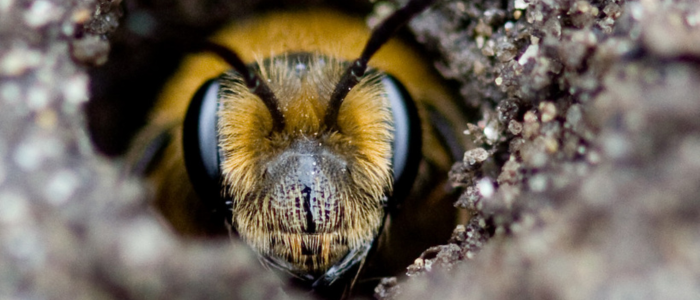
Below the small blossoms, mining bees are buzzing with activity. Each female digs her own narrow tunnel in the spring as soil warms up and loosens, forming small, temporary passageways that will serve as nests for raising their young. And after a long winter, these bees are hungry.
Early spring is a season of lean resources. Few plants risk flowering before the threat of frost has passed. But the red maple does. Its early blooms produce abundant nectar and protein-rich pollen at precisely the moment early pollinators need fuel to start nests and rear young.
Honeybees, bumblebees, cellophane bees, and sweat bees also gather nectar and pollen from the flowers. The interdependence of bees and red maple flowers is just one thread in the vast web of life, where countless species rely on one another to thrive.
It’s truly a two-way street! Red maples depend heavily on early-emerging bees for effective pollination, and thus reproduction. While wind can move pollen, insect visitors significantly increase fertilization. As bees shuttle from tree to tree, they carry the genetic future of the forest.
And the relationship doesn’t end there.
In March and April, red maples are a foundation species. Their foliage feeds numerous moth caterpillars, including some of our most spectacular natives like the cecropia moth (Hyalophora cecropia) and the vividly patterned rosy maple moth (Dryocampa rubicunda). Smaller moths in the inchworm family also rely on their leaves, transforming spring greenery into night-flying pollinators.
Gigantic, centuries-old red maples in New Jersey’s ancient, undisturbed swamp forests provide prime nesting habitat for threatened barred owls and endangered red-shouldered hawks.
Red maple seeds are eaten by squirrels, small rodents, and songbirds who nest in the branches. Other wildlife seek shelter in the trees’ canopy and in the hollows that form in aging trunks. What appears to be a single tree is, in fact, an entire neighborhood!
When we remove trees like mature red maple and plant non-native flowers and trees in our yards, we dismantle a seasonal relay of nourishment: spring nectar for bees, summer leaves for caterpillars, fall seeds for birds and mammals, year-round shelter for wildlife. To support this system, keep and replant native trees and leave patches of undisturbed soil for ground-nesting bees. Rethink pesticide use in yards and gardens. These choices may seem small, but they ripple outward; the survival of everything is braided together.
Nature is more than dramatic migrations and charismatic megafauna. The system relies on tiny bees and understated blossoms, synchronized by temperature, daylight, and evolutionary memory.
And that timing is increasingly fragile. As climate patterns shift, warmer winters and erratic cold snaps can disrupt the delicate overlap between bloom time and bee emergence – a phenomenon scientists call phenological mismatch. If the trees flower before bees are active, or bees emerge before nectar is available, both suffer.
These ecosystems are built on reciprocity and continuity. Around the maple and mining bees gathers a wider community of moths, birds, mammals, and insects, all stitched together by one early-spring bloom.
To learn about preserving New Jersey’s land and natural resources, visit the New Jersey Conservation Foundation website at www.njconservation.org or contact me at info@njconservation.org.
About the Authors
Alison Mitchell
Executive Director
Michele S. Byers
Executive Director, 1999-2021
John S. Watson, Jr.
Co-Executive Director, 2022-2024
Tom Gilbert
Co-Executive Director, 2022-2023
View their full bios here.
Filter
Get The Latest News
From The Garden State
In the
News